The short answer
Beltr is a desktop app that turns the songs you already own into karaoke, using AI that runs on your own computer. It costs $19.99 once. KaraFun Premium is $9.99 a month for a licensed streaming catalog. Pick Beltr if you want to own your setup, sing your own music and karaoke discs, and stop paying every month. Pick KaraFun if you’d rather stream from a large ready-made catalog and don’t need your own files.
What you pay, and for how long
KaraFun Premium is $9.99 a month, which is $119.88 a year, and it renews for as long as you keep it. KaraFun Pro, the plan for venues and public performance, is $49.99 a month. Both were listed with monthly billing only when checked on karafun.com in October 2026. The free tier gives you a small set of free songs, previews of the rest and one quiz.
Beltr is $19.99, once: about the price of two months of KaraFun Premium. Two years of Premium comes to $239.76 and five years to $599.40, while Beltr’s number doesn’t move. Updates are included, one license covers 2 devices, there’s no account to make and nothing to cancel, and you get a full refund within 14 days if you change your mind. Everything the one payment covers is on the pricing page.
What $19.99 doesn’t buy you
Cheaper isn’t automatically better. Here’s what you give up moving from KaraFun to Beltr, stated plainly.
No licensed catalog. Beltr has no catalog to browse or search. KaraFun’s is about 60,000 studio-recorded tracks with 400 or more added every month, and it’s the biggest difference between the two. If you want to pick any song and sing it tonight without owning it, that’s KaraFun’s job, not Beltr’s.
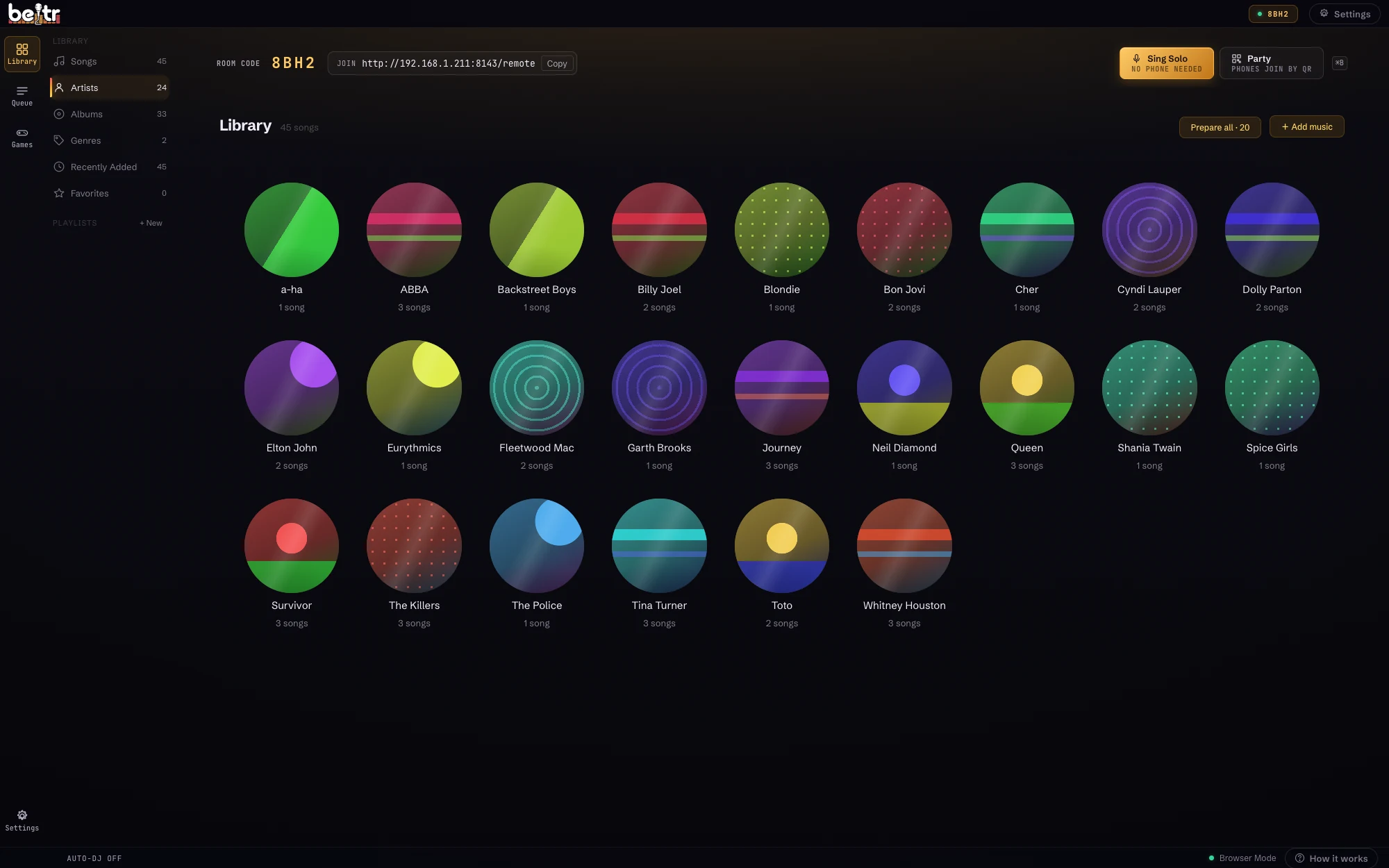
You bring the music. Beltr works on files you already have. Any MP3, FLAC, WAV or MP4 goes through separation, and CDG, MP3+G, .kar, .mid and Thai NCN karaoke files play as they are. If a song isn’t in your library, you’d have to buy it first, so a small or patchy collection gets much less out of Beltr. It arrives with one song already prepared, so you can hear it before you add your own.
AI separation, not a studio karaoke master. KaraFun’s tracks are purpose-made recordings with backing vocals and a vocal guide you can switch on. Beltr takes the vocal out of the original recording with on-device AI. On a well-recorded song the instrumental can sound very clean, but results vary with the mix, which is why the vocal fader lets you leave a little of the singer in as a guide.
A computer does the work. Separation runs on your own machine and takes a minute or two per song the first time you add it: quicker on Apple Silicon, slower on an older PC with only a CPU. KaraFun streams to a phone, tablet or computer with nothing to process. Beltr needs an Apple Silicon Mac on macOS 12 or later, a Windows 10 or 11 PC, or a Linux machine, and the installer is 700 MB to 1 GB because the whole AI engine ships inside.
If you came to KaraFun for your own discs
For years the Windows version of KaraFun, KaraFun Player, played your own CD+G, MPEG, KAR and MID files alongside the catalog. That changed with the current Windows app. KaraFun’s own product page says playback of local CDG, MP3 and MP4 files was discontinued, with an alternative described as in development, and the old Player is marked no longer supported.
Beltr is built around exactly those files. A folder of CDG or MP3+G discs, zipped or not, imports as it is, with the lyrics and timing read from the file; .kar and .mid files are rendered with their guide melody; and anything that isn’t a karaoke file yet gets its vocals removed and its lyrics timed. The guide to switching from KaraFun walks through bringing a disc collection and a favorites list across.
Why people leave subscription karaoke
The song you want isn’t there. A streaming catalog carries what’s licensed to it, and the catalog is theirs, not yours. Beltr works on music you own, so if it’s in your library you can sing it, and nobody can take it out.
You’re still being charged. A monthly plan bills whether you host karaoke twice a year or never. Beltr is one payment, so a New Year’s Eve singalong doesn’t cost you the other eleven months.
It needs the internet, and the subscription, for the phones too. KaraFun’s remote control needs an internet connection and an active subscription on the host, and choosing what guests may do needs Pro. Beltr’s rooms run on your own Wi-Fi: guests scan the code on the TV and their phones are remotes and mics, included in the price, with nothing to install.
One device at a time. A KaraFun account plays on one device at a time; a second one is blocked automatically. A Beltr license covers two computers, and every phone in the room joins free.
You don’t want your music in the cloud. Beltr runs its AI on-device, so your audio never leaves your machine. There’s nothing to upload and no account to make.
A karaoke night from the songs you own
Beltr puts your songs on the TV with the lyrics synced word by word, and a room code and QR code on screen. Guests scan it and their phones become remotes and mics, with nothing to install; the free Beltr Remote and Beltr Client apps are there if you want them. Live pitch scoring puts each singer on a leaderboard, duets score both mics, you can change the key up to 6 semitones either way, and music videos can play behind the lyrics. Afterwards, Reveal Reel turns your best take into a vertical clip, shared only when you choose. For the whole setup, from the TV to the mics, see the guide to home karaoke on your TV.